
Table of Contents
ToggleKitchen cabinet sizes follow industry standards that haven’t changed much in decades, and that’s deliberate. These measurements exist because they work: they accommodate standard appliances, fit typical countertop heights, and leave you enough elbow room to actually cook. Whether you’re replacing cabinets, building custom ones, or just figuring out what’ll fit in your space, knowing the standard dimensions saves you from expensive mistakes. This guide breaks down everything from base cabinet depths to specialty tall cabinets, so you can measure your kitchen confidently and order or build with precision.
Key Takeaways
- Standard kitchen cabinets sizes are built to industry standards—base cabinets measure 34.5 inches tall with 24-inch depth, while upper cabinets are typically 12 inches deep and positioned 18 inches above the countertop.
- Kitchen cabinet sizes come in modular widths (9, 12, 15, 18, 24, 30, 36, and 42 inches) to accommodate standard appliances and create a 36-inch counter height, the ergonomic sweet spot for food prep and dishwashing.
- Shallow base cabinets (18–20 inches) and shallow upper cabinets (9–10 inches) work well in tight spaces and modern designs but sacrifice storage capacity compared to standard depths.
- Specialty kitchen cabinet sizes include corner cabinets (24–36 inches wide), sink base cabinets (36–42 inches), and tall pantry cabinets (84–96 inches) that maximize vertical storage and require proper wall anchoring.
- Before ordering or building, measure your kitchen space at multiple points using a steel tape, note appliance locations and ceiling height, and create a to-scale floor plan to avoid costly installation errors.
- Stock cabinets offer affordability and quick delivery, while semi-custom options (2–4 week lead time) provide depth and layout flexibility, and fully custom builds (6–12 weeks) accommodate unique dimensions and specialized designs.
Standard Base Cabinet Dimensions
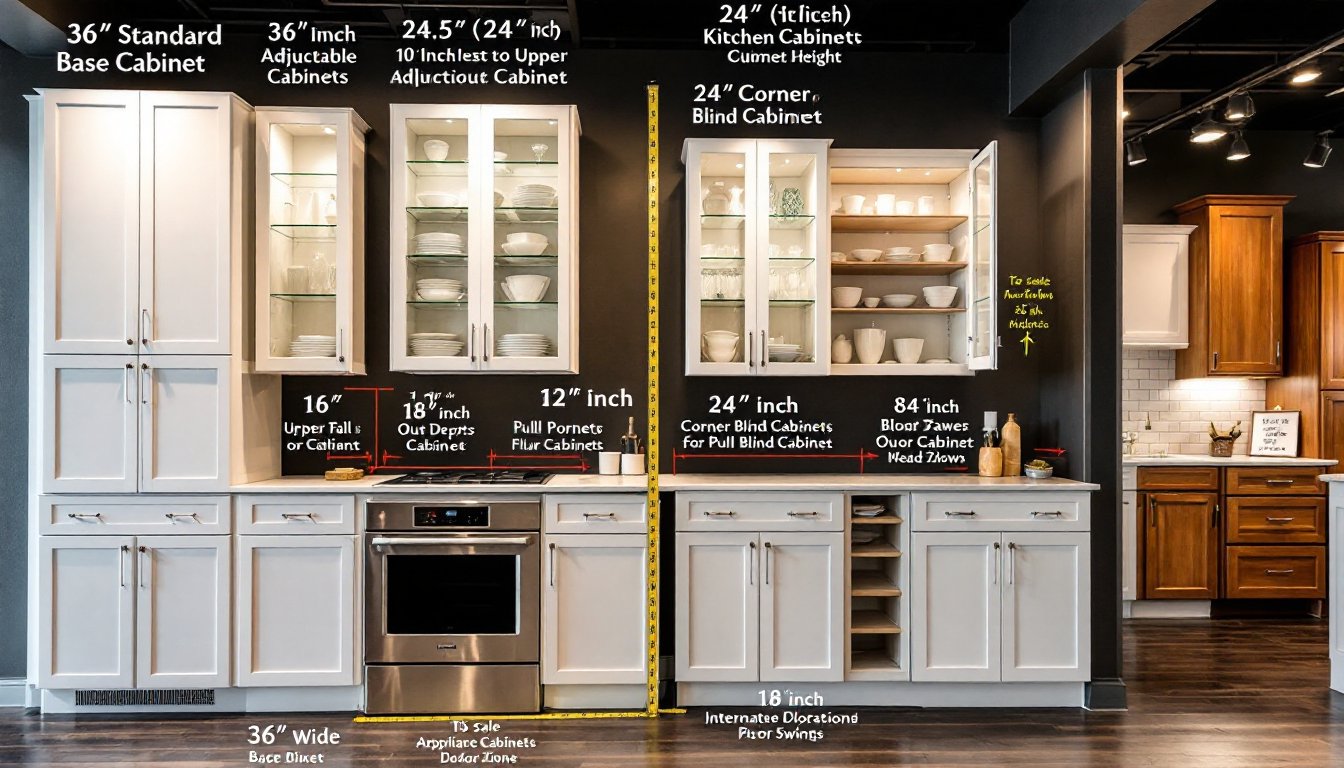
Base cabinets form the foundation of your kitchen layout, and they’re built to a near-universal standard in North America. The typical base cabinet is 34.5 inches tall (finished height before countertop) with a 24-inch depth. That 24-inch depth accommodates a standard countertop that overhangs the cabinet by 1–1.5 inches, giving you about 22 inches of usable shelf space inside.
Width varies by design. Standard base cabinets come in widths of 9, 12, 15, 18, 24, 30, 36, and 42 inches, measured from the outside. The 36-inch and 42-inch widths typically hold double doors and work well as anchor pieces under islands or sinks. Narrower 9-inch and 12-inch cabinets slip nicely between appliances or into corners.
One detail: the 34.5-inch height is measured to the top of the cabinet box, not including the countertop. Once you add a standard 1.5-inch-thick countertop, your total counter height becomes 36 inches, the ergonomic sweet spot most kitchens aim for. This height works well for most adults during food prep and dishwashing.
Inside these cabinets, shelves are typically adjustable and spaced 9 to 12 inches apart, depending on the manufacturer. If you’re retrofitting or adding shelving, keep weight distribution in mind, a full shelf of dishes or canned goods can weigh 50+ pounds, so the cabinet frame and support pegs matter.
Upper Cabinet Heights and Widths
Upper cabinets sit above your counter, and their positioning directly affects how comfortable your kitchen feels to work in. The bottom of the upper cabinet typically sits 18 inches above the countertop surface, creating a comfortable reach zone. That 18-inch gap leaves enough clearance for most standard blenders, toasters, and prep work without feeling cramped.
The distance from the countertop to the ceiling varies by home, but upper cabinets typically extend to 24 inches tall in standard installations. Some homeowners go taller, up to 30 or 36 inches, to maximize storage, though this can make the top shelves difficult to access without a step stool. If your ceiling is vaulted or unusually high, you might leave space above the cabinets for a soffit or leave it open for a more modern look.
Upper cabinet width follows the same modular logic as base cabinets: 12, 15, 18, 24, 30, 36, and 42 inches are standard widths. Narrow cabinets work above windows or between appliances, while wider options anchor wall space above sinks or stovetops. A standard 36-inch wide cabinet above a 36-inch sink or cooktop creates visual balance.
Depth is typically 12 inches, shallower than base cabinets because reaching into a deep upper cabinet is awkward and inefficient. Some premium installations use 15-inch-deep uppers, but this requires taller or taller counters to clear, and can feel overwhelming in tighter kitchens. The key measurements for kitchen design include these upper-cabinet standards, which professional designers reference consistently.
Deep vs. Shallow Cabinet Options
The choice between standard-depth and shallow cabinets affects both storage and usability. Standard depth is 24 inches for base cabinets and 12 inches for uppers, proven dimensions that fit appliances and keep items reachable. Most kitchen appliances (refrigerators, dishwashers, ranges) are built to align with 24-inch-deep base cabinets, so switching depths creates awkward gaps or requires custom modifications.
Shallow base cabinets, typically 18 or 20 inches deep, work in galley kitchens or tight spaces where a full 24-inch depth would block traffic. They sacrifice storage but open up the room visually. You’ll lose about 4 inches of shelf space, which matters if you store large pots, small appliances, or bulk dry goods. Some homeowners compensate by using taller cabinets or adding open shelving.
Shallow upper cabinets, often 9 or 10 inches deep, appear less bulky and cast less shadow over the counter. They’re popular in contemporary designs and work well in small kitchens where you don’t need massive storage. Just accept that they hold less, and avoid cramming the back shelves where items become invisible and forgotten.
Think about your actual workflow before committing to shallow cabinets. If you bake frequently, store multiple mixers, or keep canned goods stocked, standard depth gives you room to breathe. If you cook from fresh ingredients daily and prefer minimal clutter, shallow cabinets enforce a tidier, more intentional kitchen. Base cabinets deeper than 24 inches are non-standard and costly, most cabinet makers charge premium prices, and they’ll fight standard countertops and appliances.
Specialty Cabinet Sizes for Specific Needs
Beyond standard bases and uppers, kitchens often need customized pieces to fit appliances, corners, or unique layouts.
Corner cabinets address that awkward 90-degree junction. Blind corner base cabinets sit with one finished side facing out and are typically 24 or 36 inches wide, leaving 12–18 inches of internal corner space that’s tricky to access. Lazy Susan hardware helps, but the back remains a dead zone unless you opt for a rotating carousel or open shelving. Some builders use corner drawers instead, a narrower option that swings out on hinges, letting you reach deeper without the blind spot.
Sink base cabinets are typically 36 or 42 inches wide and include an open shelf or apron to accommodate the under-sink plumbing. They’re slightly shorter inside than standard base cabinets because pipes take vertical space. Plan your rough-in before ordering, sink cabinets come pre-drilled for standard configurations, but if your plumbing is unconventional, a custom cabinet or on-site modifications may be necessary.
Range hoods and cooktop cabinets demand precision. Most hoods mount to the wall at 30 inches above the cooktop, though some code jurisdictions require 36 inches. The cabinet width must match or exceed the cooktop width, typically 30, 36, or 48 inches. Ventilation cabinets often have a shallower depth (12–15 inches) to allow ductwork and filter space.
Pantry and Tall Cabinets
Pantry and tall cabinets extend from floor to ceiling, maximizing vertical storage. Standard tall cabinet heights range from 84 to 96 inches, matching typical 8-foot and 9-foot ceilings. Width is flexible, anything from 18 to 48 inches, and depth typically mirrors base cabinets at 24 inches.
Inside, shelves are adjustable and spaced 10 to 12 inches apart, which works for most packaged foods, appliances, and serving pieces. If you’re building a pantry cabinet or modifying one, consider weight capacity. A fully loaded 24-inch-deep pantry shelf can exceed 100 pounds, so use 3/4-inch plywood, support pegs every 16 inches, and anchor the cabinet to wall studs. Tall cabinets are top-heavy and unsafe if not properly braced.
Pull-out drawers and sliding shelves inside tall cabinets are smart investments, the back half of a 24-inch-deep pantry shelf is nearly inaccessible without leaning in or crouching. Hardware-store pull-out drawer slides rated for 50+ pounds work well for DIY retrofits.
Measuring Your Kitchen Space
Before ordering or building, measure twice (or three times). Start with a steel measuring tape at least 25 feet long, cloth tapes stretch and introduce errors. Measure wall length from corner to corner at three heights: floor, middle, and ceiling. Kitchens aren’t always square: walls bow slightly, and your tape will catch those imperfections.
Note the exact location of windows, doors, outlets, and gas lines. A window 10 inches from the corner changes your cabinet layout dramatically. Outlets and gas lines may require special cutouts or relocation (which might need a licensed electrician or plumber, don’t DIY this without knowledge).
Measure appliance openings carefully. If replacing a cooktop, measure the opening width, depth, and check the countertop thickness and overhang. A 30-inch cooktop doesn’t always fit a 30-inch opening due to framing or trim. Refrigerators and dishwashers have similar tolerances. Take measurements at two or three points because openings aren’t always uniform.
Draw a to-scale floor plan on graph paper or use free online tools. Mark appliance locations, cabinet widths, and door swing directions. This step prevents ordering a 36-inch cabinet that blocks the dishwasher door or bumps into a swing-out refrigerator. If you’re working with a designer or cabinet retailer, a detailed sketch saves time and money.
Custom vs. Stock Cabinet Sizing
Stock cabinets come in the standard widths and heights described above, 9, 12, 15, 18, 24, 30, 36, and 42 inches. They’re built to inventory and cost less because manufacturers amortize tooling across thousands of units. If your kitchen layout fits the grid, stock cabinets are efficient and reliable. Most home improvement stores stock them or ship within days.
Semi-custom cabinets fill the middle ground. Manufacturers offer standard widths and heights but customize depth, interior layout, finishes, and hardware. You might order a 33-inch-wide base cabinet instead of the standard 30, or a 23-inch-deep cabinet instead of 24. Lead times stretch to 2–4 weeks, and costs rise 20–40% compared to stock, but you gain flexibility without full custom pricing.
Fully custom cabinets are built to your exact dimensions and specifications. Need a 37-inch-wide cabinet to fit an odd space? A 27-inch-deep base? Curved doors? Custom shops deliver it. Lead times run 6–12 weeks, and costs can double or triple stock prices, but you’re not forcing your layout into a grid.
For DIYers building cabinets, free woodworking plans and furniture building tutorials provide dimensioned drawings you can adapt. The key is building to your space, not assuming standard sizes will work everywhere. Use plywood 3/4-inch-thick for cabinet boxes to handle everyday wear, and reinforce corners and shelves with pocket-hole joinery or dado joints. Building custom means taking responsibility for precision, measure before every cut.